BOJ Tankan June 2026: Large Manufacturers' DI Jumps to +22, Highest Since 2018, Beating Firms' Own Forecast by 8 PointsA · FULL TRANSLATION
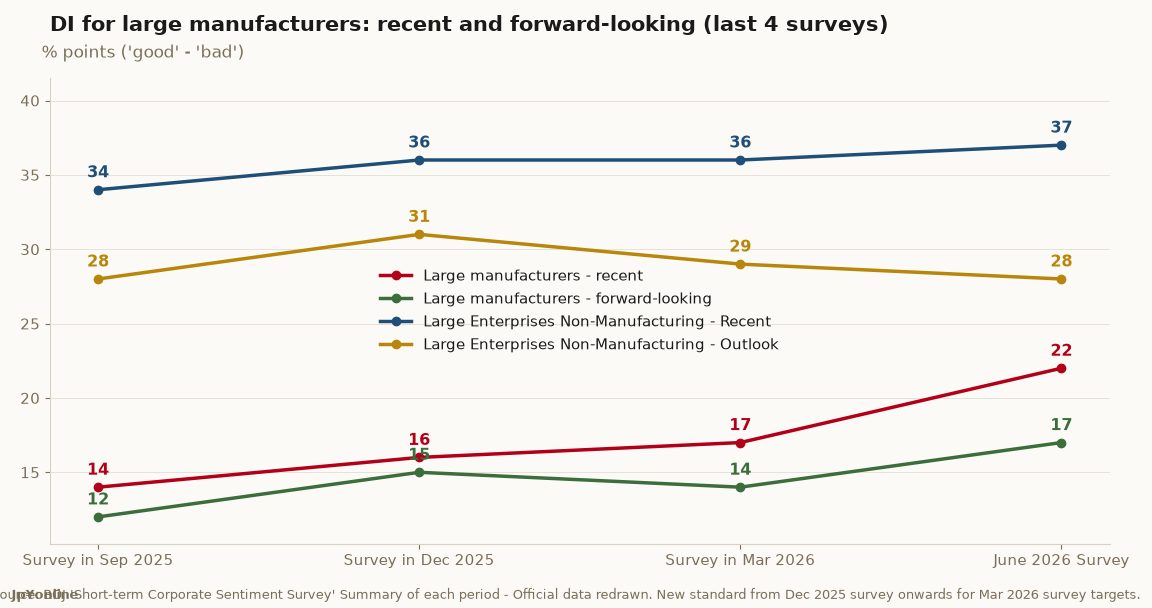
- The June 2026 Tankan (209th survey) was released 1 July at 8:50 JST. The large manufacturers' business conditions DI came in at +22, up 5 points from +17 in March, the highest since the March 2018 survey and a fifth straight quarterly improvement.
- The gap is against expectations: in March these same firms forecast +14 for this quarter. The actual reading was +22, eight points higher. Large non-manufacturers showed the same 8-point gap (forecast +29, actual +37).
- Private forecasters also missed. Daiwa Institute of Research, publishing on 17 June, projected +14 for large manufacturers, a 3-point decline; the index rose 5 points instead.
- Large non-manufacturers held at +37, up 1 point. Accommodation and food services rose from +34 to +46, the largest gain among non-manufacturing sectors.
- Every size band and sector forecasts deterioration ahead. Large manufacturers see +17 next quarter, non-manufacturers +28, and small manufacturers just +2.
The Tankan is Japan's largest quarterly business survey. This round covered 9,141 firms with a 99.4% response rate, surveyed between 28 May and 30 June. The DI is the share of firms answering "good" minus the share answering "bad."
What matters is how far +22 sat from expectations. Three months ago these same companies forecast +14 for this quarter. They delivered +22. Large non-manufacturers missed their own forecast by the same 8 points, and Daiwa Institute of Research was still projecting a decline as late as 17 June.
The sector detail shows where it came from: non-ferrous metals rose from +23 to +36, production machinery from +26 to +36, electrical machinery from +22 to +29, all tied to semiconductor and data-centre equipment. Petroleum and coal products fell from +18 to +9.
The second half of the survey is less comfortable. Forward readings fall across the board: large manufacturers to +17, large non-manufacturers to +28, small non-manufacturers to +8. For the yen, a strong Tankan widens the room for the BOJ to raise rates, while weak forward readings remove the urgency.
This site begins tracking this series now, following the same two figures each quarter: the current and forward DI, and the gap between them.
Translated from the Bank of Japan Research and Statistics Department, "Tankan (Summary) — June 2026" (209th Short-Term Economic Survey of Enterprises in Japan), released 1 July 2026.
SURVEY OUTLINE. Firms surveyed: 9,141 nationwide (3,792 manufacturing, 5,349 non-manufacturing), of which 1,636 large, 2,599 medium-sized and 4,906 small enterprises. Response rate 99.4%. Survey period: 28 May to 30 June.
I. BUSINESS CONDITIONS ("favourable" minus "unfavourable", percentage points)
Large enterprises. Manufacturing: March 2026 survey, current +17, forecast +14; June 2026 survey, current +22 (change +5), forecast +17 (change −5). Non-manufacturing: March, current +36, forecast +29; June, current +37 (+1), forecast +28 (−9). All industries: March, current +27, forecast +21; June, current +29 (+2), forecast +23 (−6).
Medium-sized enterprises. Manufacturing, June: current +17 (+1), forecast +9 (−8). Non-manufacturing: current +26 (−1), forecast +16 (−10). All industries: current +22 (−1), forecast +13 (−9).
Small enterprises. Manufacturing, June: current +9 (+2), forecast +2 (−7). Non-manufacturing: current +15 (−1), forecast +8 (−7). All industries: current +13 (unchanged), forecast +6 (−7).
All enterprises. Manufacturing: current +14 (+2), forecast +7 (−7). Non-manufacturing: current +21 (unchanged), forecast +14 (−7). All industries: current +18 (unchanged), forecast +11 (−7).
Selected industries, large enterprises (March, then June): non-ferrous metals +23, +36; production machinery +26, +36; business-oriented machinery +15, +23; electrical machinery +22, +29; shipbuilding and heavy machinery +35, +39; chemicals +14, +20; petroleum and coal products +18, +9; iron and steel −15, −6. Non-manufacturing: construction +55, +52; real estate +55, +52; accommodation and food services +34, +46; retailing +26, +33; information services +52, +52.
II. SUPPLY-DEMAND, INVENTORY AND PRICE JUDGEMENT (percentage points)
Large manufacturers. Domestic supply-demand conditions ("excess demand" minus "excess supply"): March −7, June −4, forecast −3. Output prices ("rise" minus "fall"): March +28, June +40 (change +12), forecast +43. Input prices: March +46, June +62 (change +16), forecast +59.
Small manufacturers. Output prices: March +31, June +40 (+9), forecast +52. Input prices: March +62, June +76 (+14), forecast +77.
NOTES. 1. Response rate = number of valid responses on business conditions divided by number of firms surveyed, times 100. 2. The change in "current" is measured against "current" in the previous survey; the change in "forecast" is measured against "current" in the present survey. 3. "Shipbuilding and heavy machinery" refers to transport equipment other than motor vehicles.